⏱ Estimated Reading Time: 10–12 Minutes
Siemens has been at the forefront of industrial automation for more than six decades, with its SIMATIC range of Programmable Logic Controllers (PLCs) becoming one of the most trusted automation platforms in the world. Across Australia, Siemens PLCs are used in manufacturing facilities, food and beverage plants, mining operations, water treatment facilities, infrastructure projects and countless OEM machines.
From compact standalone machines to highly complex process control systems, Siemens offers PLC platforms designed to suit almost every industrial application. While the modern S7-1200 and S7-1500 controllers continue to drive new automation projects, many Australian businesses still rely on legacy S7-300 and S7-400 systems that have delivered reliable performance for decades.
Understanding the differences between these PLC families is becoming increasingly important. Engineers responsible for maintaining existing equipment need to know which platforms remain supported, when repairs are a practical option and how to plan future migration strategies without creating unnecessary downtime.
Whether you’re selecting a PLC for a new installation, maintaining an ageing production line or sourcing Siemens PLC spare parts, choosing the right platform can significantly influence system reliability, lifecycle costs and future upgrade flexibility.
In this guide, we’ll compare the major Siemens PLC families, explain where each controller is commonly used, discuss their lifecycle status and provide practical guidance for maintaining both current and legacy Siemens automation systems.
This guide is ideal for maintenance managers, automation engineers, electricians, system integrators, OEM machine builders and procurement professionals responsible for Siemens automation systems.
In this guide, you will learn:
| PLC Family | Best For | Lifecycle Status | Common in Australia? |
|---|---|---|---|
| LOGO! | Small automation projects | Current | ✅ Yes |
| S7-1200 | Small to medium machines | Current | ✅ Yes |
| S7-1500 | Advanced industrial automation | Current | ✅ Yes |
| S7-300 | Manufacturing & OEM equipment | Legacy | ✅ Yes |
| S7-400 | Large process industries | Legacy | ✅ Yes |
A Siemens PLC (Programmable Logic Controller) is an industrial computer designed to monitor inputs, execute programmed logic and control outputs in real time. These controllers form the foundation of countless automation systems, enabling machines and industrial processes to operate safely, efficiently and consistently.
Unlike general-purpose computers, Siemens PLCs are engineered to withstand harsh industrial environments, including vibration, electrical noise, temperature fluctuations and continuous 24-hour operation. Their reliability has made them a preferred choice for industries where unexpected downtime can result in significant production losses.
Today, Siemens PLCs are commonly used to control:
One of the key strengths of Siemens automation is its scalable product portfolio. Whether controlling a small standalone machine or an entire manufacturing facility, Siemens provides PLC platforms that can be matched to the size and complexity of the application while maintaining a consistent engineering environment through the TIA Portal software platform.
Industrial automation has evolved significantly over the past several decades, and Siemens has continuously developed new PLC platforms to meet changing industry requirements. Rather than replacing one controller generation overnight, Siemens has introduced new families while many older systems continue operating reliably in production environments.
This gradual evolution is one of the reasons Siemens PLCs remain so widely used throughout Australian industry. Many facilities continue maintaining proven legacy systems while strategically upgrading new projects to the latest technology.
| PLC Family | Introduced | Lifecycle Status |
|---|---|---|
| SIMATIC S5 | 1979 | Obsolete |
| S7-200 | 1994 | Legacy |
| S7-300 | 1995 | Legacy |
| S7-400 | 1996 | Legacy |
| S7-1200 | 2009 | Current |
| S7-1500 | 2013 | Current |
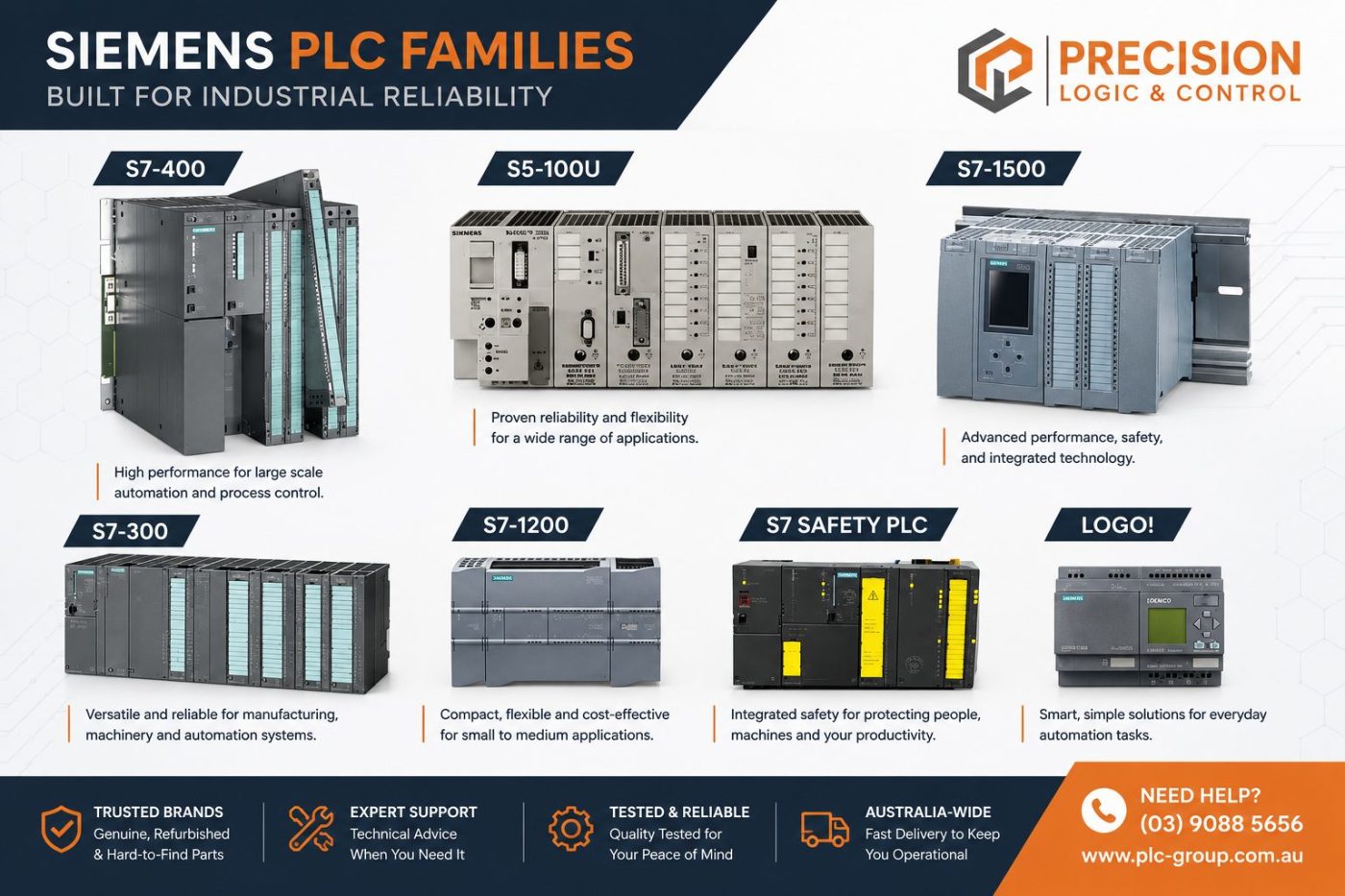
The Siemens LOGO! is the smallest controller in the SIMATIC family and is designed for simple automation tasks. Although it is often described as a “smart relay,” the LOGO! offers programmable logic, timers, counters and communication capabilities that make it suitable for a wide range of small control applications.
It is commonly used where a full PLC would be unnecessarily complex or expensive.
The S7-1200 is Siemens’ entry-level PLC for industrial automation and is one of the most widely deployed controllers for new machine installations. It combines powerful processing, integrated communication and straightforward programming within the TIA Portal engineering environment.
Designed for small to medium-sized automation projects, the S7-1200 provides an excellent balance between performance, scalability and affordability.
For businesses building new machinery, the S7-1200 has become one of the preferred PLC platforms due to its reliability, flexibility and long-term manufacturer support.
The S7-1500 represents Siemens’ flagship PLC platform for modern industrial automation. It is designed for demanding applications requiring high processing performance, advanced diagnostics, integrated safety and extensive networking capabilities.
Compared with earlier Siemens PLC generations, the S7-1500 delivers faster execution speeds, enhanced cybersecurity features and improved engineering efficiency through the Totally Integrated Automation (TIA) Portal ecosystem.
For new industrial automation projects requiring long-term support and advanced functionality, the S7-1500 has become Siemens’ recommended platform.
Although officially classified as a legacy platform, the S7-300 remains one of the most commonly encountered Siemens PLC families across Australian manufacturing facilities.
Thousands of production lines continue operating successfully using S7-300 controllers because they have proven exceptionally reliable over many years of continuous operation. For many organisations, replacing an entire S7-300 system requires substantial engineering resources, production downtime and capital investment.
As a result, maintenance teams often choose to continue supporting these systems by sourcing quality replacement modules, maintaining spare parts inventory and repairing existing equipment where practical.
While Siemens no longer manufactures many S7-300 products, these controllers continue to play a critical role in industrial automation, making lifecycle planning and spare parts management increasingly important.
The S7-400 was developed for large-scale automation systems requiring exceptional reliability, redundancy and high processing capacity. It became a preferred platform for industries where continuous operation is essential and system failures can result in significant operational or financial consequences.
Although now considered a legacy platform, the S7-400 remains widely installed in major industrial facilities throughout Australia.
For many organisations, maintaining an existing S7-400 installation remains a practical and cost-effective strategy while long-term migration plans are developed.
Selecting the right Siemens PLC depends on the complexity of your application, performance requirements, expansion needs and long-term maintenance strategy.
| PLC Family | Recommended For | Best Choice When… |
|---|---|---|
| LOGO! | Basic automation | You need simple, low-cost control. |
| S7-1200 | Small to medium machines | Flexibility and affordability are priorities. |
| S7-1500 | Advanced automation | Performance, diagnostics and future scalability are critical. |
| S7-300 | Existing installations | Maintaining reliable legacy equipment. |
| S7-400 | Large industrial systems | Supporting complex process control and high-availability applications. |
Don’t replace a Siemens PLC simply because it has reached legacy status.
Many S7-300 and S7-400 systems continue operating reliably after decades of service. Before planning a migration, evaluate the controller’s condition, spare parts availability, software compatibility and the operational impact of an upgrade.
A well-maintained legacy PLC can often deliver many additional years of dependable performance while allowing upgrades to be scheduled around production requirements rather than unexpected failures.
One of the biggest mistakes businesses make is replacing a Siemens PLC simply because it has reached legacy status.
Many S7-300 and S7-400 systems continue to operate reliably after decades of service. Replacing an entire control system without assessing its condition, spare parts availability and production requirements can result in unnecessary costs and avoidable downtime.
Instead, develop a structured lifecycle strategy that balances maintenance, spare parts planning and future migration projects.
The S7-1200 is designed for small to medium-sized automation projects, while the S7-1500 provides higher processing performance, advanced diagnostics, integrated safety and greater scalability for complex industrial applications.
Yes. Siemens has classified the S7-300 as a legacy platform. However, thousands of S7-300 systems remain in service across Australia and continue operating reliably with appropriate maintenance and spare parts support.
Many Siemens PLCs can still be repaired depending on the model, fault type and component availability. Repair is often a cost-effective option for legacy systems where replacing the entire control platform is unnecessary.
For most new industrial automation projects, Siemens recommends the S7-1200 for small to medium applications and the S7-1500 for larger, high-performance automation systems.
Yes. New, refurbished and surplus Siemens PLC spare parts remain available through specialist automation suppliers, helping businesses extend the life of existing control systems.
Yes, although the migration usually requires engineering work, software conversion, hardware redesign and production planning. Many businesses choose to migrate gradually during planned shutdowns.
Modern Siemens PLCs are programmed using the Totally Integrated Automation (TIA) Portal. Older controllers may also use STEP 7 depending on the PLC family and project requirements.
Specialist industrial automation suppliers can assist with sourcing new, refurbished and obsolete Siemens PLC components, along with repair services and technical support for legacy systems.
Siemens has developed one of the world’s most comprehensive PLC portfolios, supporting everything from small standalone machines to complex industrial processes. While the latest S7-1200 and S7-1500 platforms continue to power new automation projects, legacy S7-300 and S7-400 systems remain an essential part of Australian industry.
Rather than replacing equipment solely because it has reached legacy status, businesses should evaluate system performance, spare parts availability, production requirements and long-term maintenance strategies. A well-maintained Siemens PLC can often continue operating reliably for many years while providing time to plan future upgrades around scheduled maintenance rather than unexpected breakdowns.
Understanding the strengths and lifecycle of each Siemens PLC family enables maintenance teams, engineers and procurement professionals to make informed decisions that minimise downtime and maximise the return on existing automation assets.
Whether you’re maintaining a legacy S7-300 system, upgrading to an S7-1500 or searching for hard-to-find Siemens PLC spare parts, Precision Logic & Control can help. We supply tested Siemens automation components, repair services and lifecycle support to manufacturers, OEMs and industrial facilities across Australia.
© Copyright 2026. Precision Logic & Controls All Rights Reserved.