Programmable Logic Controllers (PLCs) are the backbone of modern industrial automation. Whether controlling production lines, water treatment plants, mining operations or manufacturing facilities, PLCs play a critical role in maintaining productivity, reliability and operational efficiency.
Two of the most widely used PLC platforms in the world are Allen Bradley and Siemens. Both manufacturers offer powerful automation solutions, extensive product ranges and proven performance across a wide range of industries.
For Australian manufacturers considering a new automation project, system upgrade or migration strategy, understanding the differences between these platforms can help ensure the right long-term investment.
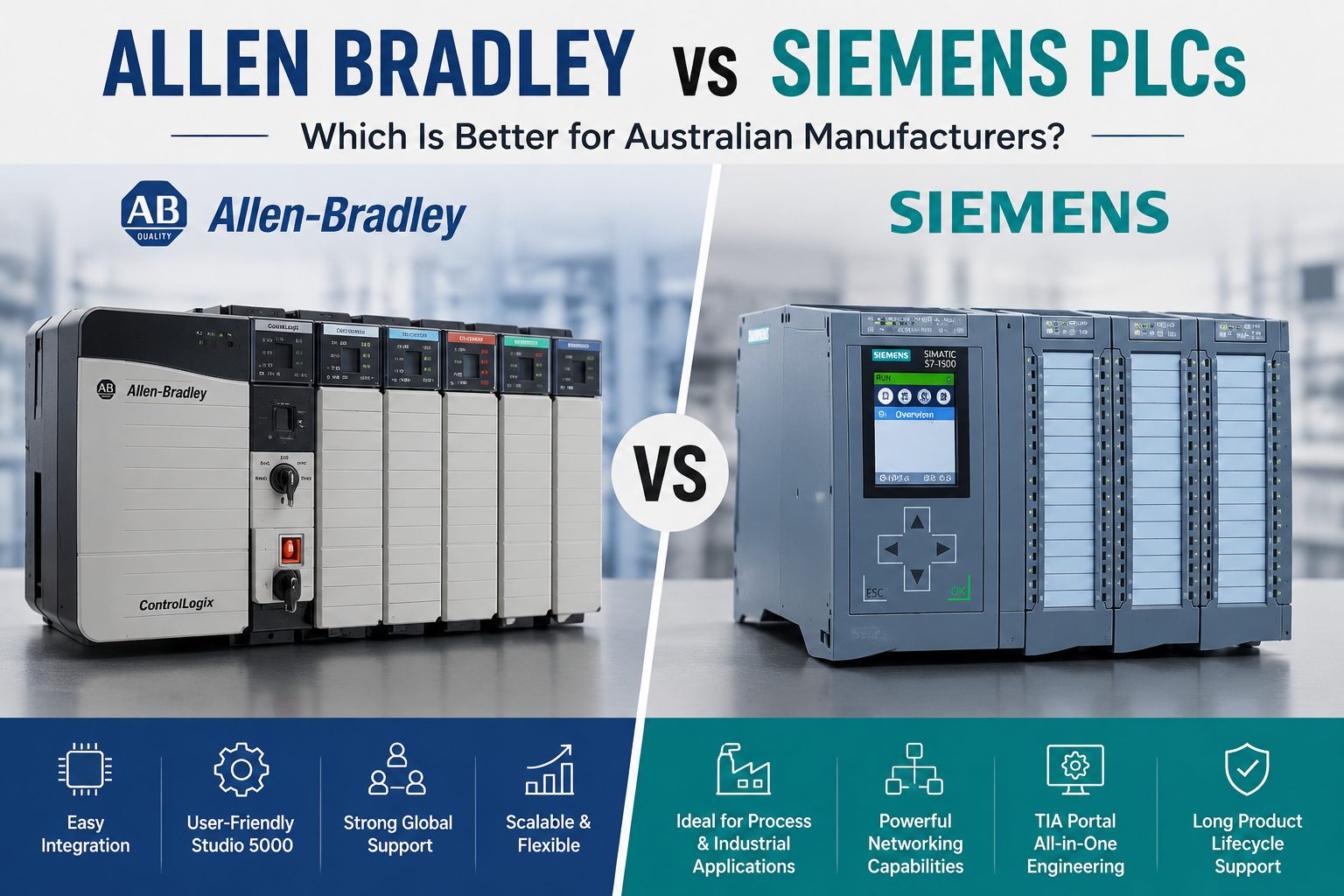
Allen Bradley, manufactured by Rockwell Automation, is one of the most recognised automation brands globally. It is particularly popular in North America and is widely used across manufacturing, food processing, automotive and packaging industries.
The Allen Bradley ControlLogix and CompactLogix product families are known for their scalability, ease of integration and extensive support ecosystem.
Key advantages of Allen Bradley PLCs include:
For facilities already using Rockwell automation products, Allen Bradley PLCs often provide a seamless integration path.
Siemens is one of the world’s largest industrial automation manufacturers and has a particularly strong presence throughout Europe, Asia and Australia.
The SIMATIC range, including the S7-1200, S7-1500 and legacy S7-300 platforms, is widely used in industries such as water treatment, mining, energy, infrastructure and process manufacturing.
Key advantages of Siemens PLCs include:
Siemens systems are often favoured for complex process control applications and large-scale infrastructure projects.
One of the biggest differences between the two platforms is the programming environment.
Allen Bradley PLCs are typically programmed using Studio 5000, which is widely regarded as intuitive and easy to navigate for maintenance personnel and control engineers.
Siemens PLCs are programmed using TIA Portal, which offers a highly integrated engineering environment combining PLC programming, HMI development and network configuration within a single platform.
While both systems support IEC 61131 programming standards, engineers often have strong preferences based on familiarity and project requirements.
When selecting a PLC platform, it is important to consider long-term maintenance and spare parts availability.
Many facilities continue to operate legacy systems long after manufacturers have released newer generations of hardware. As systems age, sourcing replacement processors, communication modules, HMIs and I/O cards can become increasingly challenging.
Both Allen Bradley and Siemens have extensive installed bases across Australia, which generally makes sourcing spare parts easier than less common automation platforms. However, obsolete components can still present significant challenges, particularly for ageing systems.
Developing a proactive spare parts strategy can help minimise downtime and reduce operational risk.
The reality is that there is no single “best” PLC platform.
Allen Bradley may be the preferred choice when:
Siemens may be the preferred choice when:
The right solution ultimately depends on operational requirements, existing infrastructure, engineering expertise and long-term maintenance considerations.
Both Allen Bradley and Siemens offer highly capable PLC platforms trusted by industrial facilities worldwide. Selecting the right system requires careful consideration of operational goals, support requirements, lifecycle management and future expansion plans.
For many Australian manufacturers, the decision is less about choosing the “best” PLC and more about selecting the platform that aligns with existing assets, available expertise and long-term business objectives.
Both Siemens and Allen Bradley have significant installed bases throughout Australia. Siemens is particularly common in infrastructure, water and process industries, while Allen Bradley is widely used in manufacturing and packaging facilities.
Yes. Many obsolete PLC processors, HMIs, communication modules and I/O cards can still be sourced through specialist automation suppliers and global inventory networks.
Yes. As hardware becomes obsolete and support availability decreases, organisations should develop migration strategies to reduce operational risk and improve long-term maintainability.
Yes. Precision Logic & Control provides automation support, PLC programming assistance and obsolete parts sourcing for a wide range of industrial automation platforms, including Siemens and Allen Bradley systems.
© Copyright 2026. Precision Logic & Controls All Rights Reserved.