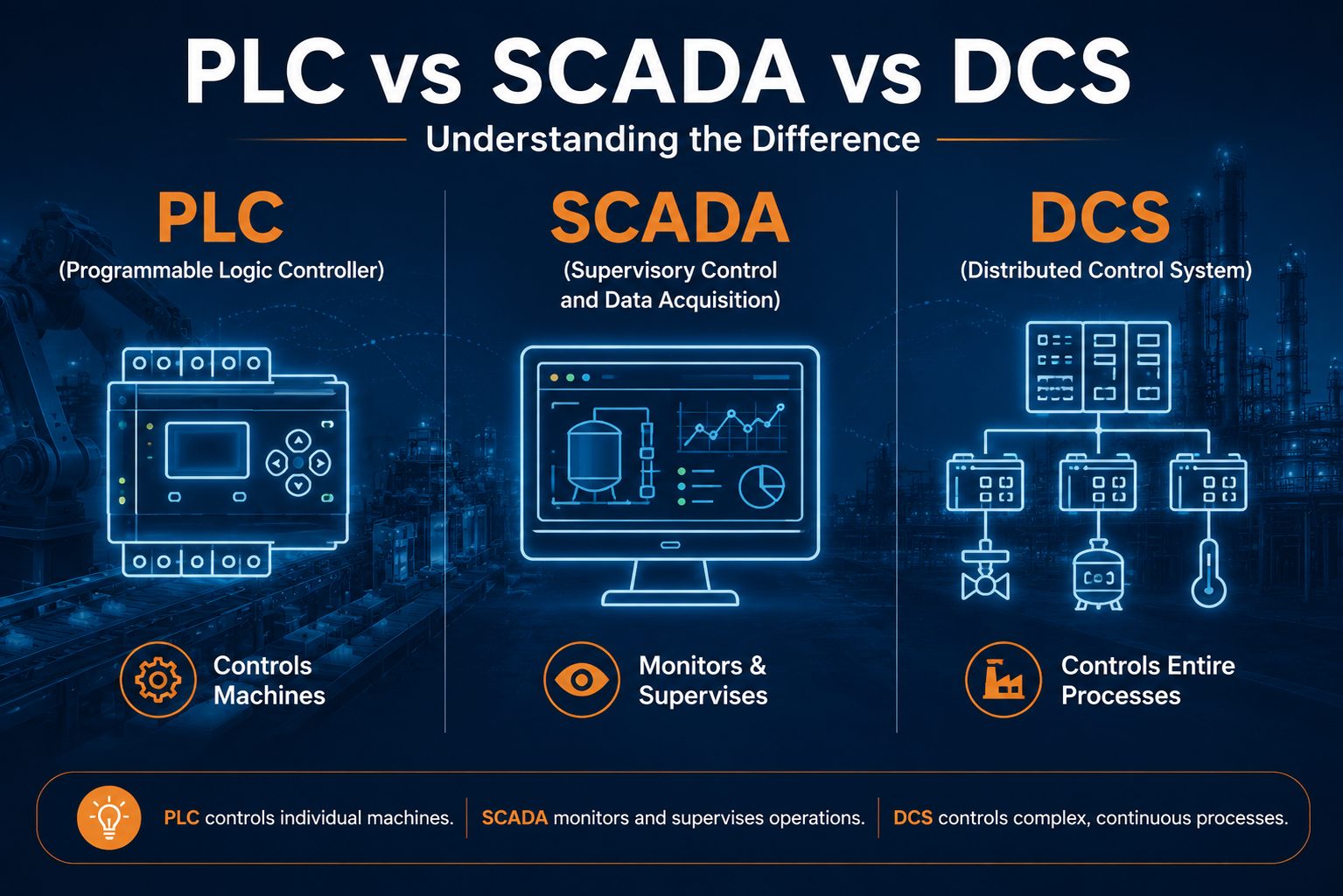
PLC, SCADA and DCS are three of the most commonly used technologies in industrial automation. Although they often work together, each performs a different role within an automation system.
Understanding these differences helps engineers, maintenance teams and business owners make informed decisions when designing, maintaining or upgrading industrial control systems.
A Programmable Logic Controller (PLC) is an industrial computer designed to control machinery and equipment in real time.
PLCs receive signals from sensors, process logic and control outputs such as motors, valves and conveyors.
They are commonly used for:
PLCs are known for their reliability, flexibility and ability to operate in demanding industrial environments.
Supervisory Control and Data Acquisition (SCADA) is software used to monitor, supervise and manage industrial processes.
Unlike a PLC, SCADA does not directly control machinery. Instead, it collects information from PLCs and other field devices, providing operators with a central view of plant operations.
Typical SCADA features include:
A Distributed Control System (DCS) is designed for large, continuous industrial processes.
Rather than relying on individual PLCs controlling separate machines, a DCS distributes control functions across multiple controllers that operate together as one integrated system.
DCS platforms are commonly used in:
| Feature | PLC | SCADA | DCS |
|---|---|---|---|
| Primary Function | Machine Control | Monitoring & Supervision | Process Control |
| Real-Time Control | ✔ Yes | Limited | ✔ Yes |
| Data Collection | Limited | Extensive | Extensive |
| Operator Interface | Basic | Advanced | Advanced |
| Best For | Individual Machines | Entire Facilities | Continuous Processes |
| Typical Industries | Manufacturing, Packaging, Logistics | Manufacturing, Water Treatment, Utilities | Oil & Gas, Chemical, Power Generation |
| Main Purpose | Controls machines | Monitors operations | Controls continuous processes |
Absolutely.
A typical industrial automation system often combines all three technologies.
For example:
Each technology complements the others to improve efficiency, safety and operational visibility.
The answer depends on:
Many manufacturers use PLCs with SCADA software, while larger process industries often implement DCS platforms.
Precision Logic & Control provides industrial automation support across Australia, including PLC programming, SCADA systems, replacement automation components and technical assistance for both current and legacy control systems.
Whether you’re upgrading an existing installation or maintaining older automation equipment, our experienced team can help identify the most suitable solution.
No. A PLC controls machinery, while SCADA monitors and supervises industrial processes.
Yes. Many standalone machines use PLCs without SCADA software.
DCS systems are widely used in continuous process industries such as oil and gas, chemical manufacturing, water treatment and power generation.
PLCs, SCADA systems and DCS platforms each play an important role in industrial automation. Understanding how they differ allows businesses to choose the right technology for their operations while improving productivity, reliability and long-term performance.
© Copyright 2026. Precision Logic & Controls All Rights Reserved.